By Eduardo Baptista
BEIJING, Dec 1 (Reuters) - China's first crewed spacecraft to be ruled unfit to fly in mid-mission will be sent back to Earth for experts to assess the damage it sustained more closely, state broadcaster CCTV reported on Monday.
On November 5, the Shenzhou-20 spacecraft was meant to bring its crew back to China just after finishing a six-month stay aboard Beijing's permanently inhabited space station Tiangong.
But after the Shenzhou-20 crew discovered a crack in the window of the vessel's return capsule right before takeoff, the return mission was delayed - a first in China's human spaceflight program.
The vessel's crew was forced to return to Earth in a different spaceship nine days later, temporarily leaving Tiangong and its remaining trio of resident astronauts without a flightworthy vessel.
China's space-industrial complex raced to remove that risk by working overtime to execute its first emergency launch mission on November 25, just 20 days after the initial delay was announced.
But the future of the damaged Shenzhou-20 vessel, which remains docked at the Chinese space station, was unknown until CCTV's televised report on Monday.
Ji Qiming, a spokesperson for the China Manned Space Agency, told the state broadcaster that Shenzhou-20 would return without crew to Earth, adding that on its way back it would "obtain the most authentic experimental data", without elaborating further.
Jia Shijin, a designer of the Shenzhou spacecraft, revealed to CCTV more details about the tiny crack that permanently altered China's crewed spaceflight schedule.
"Our preliminary judgement is that the piece of space debris was smaller than 1 millimetre, but it was travelling incredibly fast. The resulting crack extends over a centimetre," Jia said.
"But we can't directly examine it in orbit, we will study it closely when Shenzhou-20 returns."
Jia added that the decision to delay the Shenzhou-20 return mission was based on a worst-case scenario where the window crack might spread, leading to cabin depressurisation and the ingress of high-speed gases.
If this happened, it could then rapidly overwhelm life-support systems and prove fatal to the astronauts.
(Reporting by Eduardo Baptista; editinjg by Mark Heinrich)
LATEST POSTS
- 1
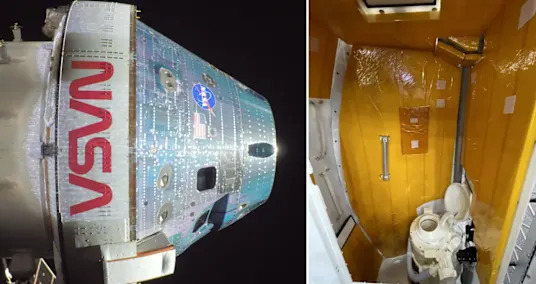
 There was a bit of toilet trouble on NASA's Artemis 2 mission to the moon
 - 2The breakout star of NASA's Artemis 2 moon mission isn't an astronaut — it's the space toilet
- 3A definitive Manual for Choosing Indoor Plants Ideal for Your Space
- 4Displaced Palestinian families suffer as heavy rains flood Gaza tent camps
- 5Shah Capital pushes for Novavax sale, warns of proxy fight


- Which sandwich do you find totally delectable? !
- If evolution is real, then why isn’t it happening now? An anthropologist explains that humans actually are still evolving
- Our favorite Space.com stories of 2025
- Vote in favor of your Favored kind of footwear
- Viruses aren’t all bad: In the ocean, some help fuel the food web – a new study shows how
- Spots To Go Birdwatching All over the Planet
- German finance minister seeks better market access in China talks
- NASA is sending astronauts back to the moon. Can you see the Artemis 4 landing sites from Earth?
- Extraordinary Shows to Long distance race on a Plane