When you buy through links on our articles, Future and its syndication partners may earn a commission.

You've probably heard it said by now: NASA's Artemis 2 mission was the first to launch astronauts toward the moon in more than 50 years. But that was just the first of the firsts that this mission would achieve. In fact, you may have go back just as long in space history to find another spaceflight with as many firsts and records broken.
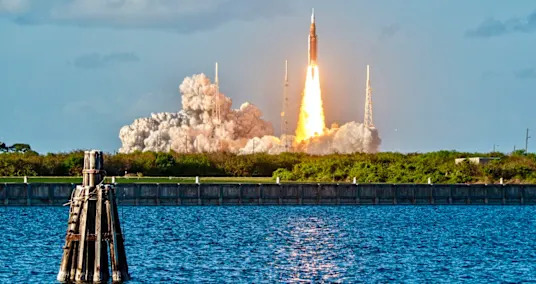
Artemis 2 launched on April 1. And it's no joke that the 10-day flight is an ambitious shakeout cruise for NASA's Orion spacecraft, which is carrying the crew on a free-return trajectory out beyond the moon and back again. The mission is testing the space capsule's life support system and demonstrating its ability to maneuver during rendezvous and (simulated) docking activities.
Furthermore, it moves NASA one step closer to returning astronauts to the moon's surface and, as recently announced, establishing a sustainable, permanent moon base over the course of the decade.
Mission milestones
The firsts began at launch. Artemis 2 marked the first time that a crew lifted off on board an Orion spacecraft atop a Space Launch System (SLS) rocket. The vehicles had flown together only once before, on the 2022 Artemis 1 mission, but without humans aboard.
This was also NASA's first crewed launch to be overseen by a female launch director, Charlie Blackwell-Thompson, from the Launch Control Center (LCC) at the Kennedy Space Center. She previously was a test director during the space shuttle program and was launch director for the uncrewed Artemis 1 launch.
After completing a series of proximity operations with the SLS' upper stage as a target, the Artemis 2 Orion (named "Integrity") entered a free-return trajectory — essentially a "figure 8" path that took the crew around the moon relying on gravity alone to bring them back to Earth. While some of the early Apollo missions began their journey on a free-return path, they then fired their engine to enter lunar orbit.

Only Apollo 13 completed a full free return, and that was forced by not knowing the status of the service module's engine after a mid-flight explosion. Artemis 2 is the first crewed flight to follow a full free-return trajectory under nominal conditions.
And speaking of Apollo 13: That 1970 mission had held the distance record for humanity, getting 248,655 miles (400,171 kilometers) away from Earth. But Artemis 2 broke that mark during its loop around the moon on Monday (April 6), reaching a maximum distance of 252,757 miles (406,773 km).
The Artemis 2 astronauts have also seen parts of the far side of the moon never before directly viewed by humans. And that's important to scientists: Geologists on the mission team believe that the qualities of the human eye can discern characteristics on the lunar surface that cameras cannot resolve or reveal as clearly.
After their April 10 splashdown, the Artemis 2 crew will be the first to be recovered by a San Antonio-class amphibious transport dock ship operated by the U.S. Navy. During Apollo, aircraft carriers and helicopters were used to recover the command module and crew, respectively. For Artemis, the astronauts will remain on board their capsule until the ship has enveloped the Orion in its well deck.
The Artemis 2 mission is also the first to fly four astronauts to the moon on one spacecraft; the first moon mission to include a toilet (the Apollo astronauts used collection bags); and the first crewed deep-space mission to test an optical communications system, a laser terminal that transmits data over laser links.

Crew qualifications
In addition to the Artemis 2 spacecraft and mission plan, the four astronauts have also set firsts based on who they are.
Commander Reid Wiseman and mission specialist Jeremy Hansen are the first "Chumps" to fly to the moon. The "Chumps" is the nickname that was given to their class of astronaut candidates, who were selected in 2009.
Likewise, pilot Victor Glover and mission specialist Christina Koch are the first members of the "8 Balls" to fly by the moon, having both been chosen with the 2013 group of candidates.
Wiseman is the first person born in Maryland to fly to the moon, which the crew reached early Monday morning when they entered the lunar "sphere of influence." Hansen is not only the first Canadian to fly to the moon, but also the first non-American to do so.
Koch is the first woman to fly to the moon. She also holds the record as one of the first two women to perform an all-female spacewalk and the woman to spend the longest time in space on a single mission, at 329 days.
Glover is the first person of color to fly to the moon. NASA did not accept minorities into its astronaut corps until 1978, six years after the last Apollo astronauts launched for the moon.
Koch is the first person to have attended U.S. Space Camp at the U.S. Space & Rocket Center in Huntsville, Alabama and then fly to the moon. She is also the first Astronaut Scholar to fly the moon, having been supported during her undergraduate education by the Astronaut Scholarship Foundation founded by the Mercury 7 astronauts.
LATEST POSTS
- 1
 New research reveals urban raccoons across the US show early signs of domestication
 - 2Potential Houthi threat to Red Sea shipping could further damage global economy
- 3She's been a Bond girl and a mutant. Now she's grappling with Hollywood's obsession with 'eternal youth.'
- 4UN rights chief: Israel's new Gaza aid agency rules 'outrageous'
- 5Pfizer in $41.5 million settlement with Texas over ADHD drug for children




- Changes to CDC website spark debate over autism and vaccine misinformation
- A definitive Cruiser Standoff: Decision in favor of Your #1 Ride
- Here are 10 stores where you can get a free Thanksgiving turkey
- Central African Republic's president sworn in for a third term after disputed election
- Cocaine, caffeine, painkillers consumed by sharks in Bahamas, study finds
- Will Comet C/2025 R3 (PanSTARRS) be the 'great comet' of 2026?
- American tourists left stranded in the Caribbean following flight cancellations after airspace closed for Maduro operation
- Picking the Right Doctor prescribed Medication Inclusion in Senior Protection.
- I visited every country by 25. Antarctica showed me how much I still hadn't seen.