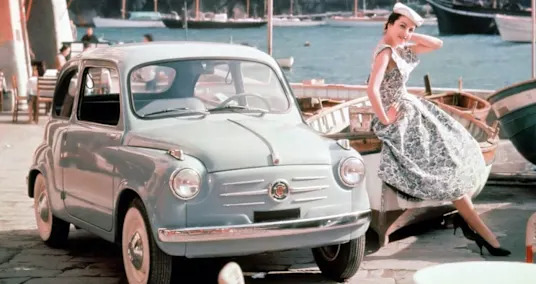
Most people in the Balkans immediately recognize the small car that helped motorize an entire generation. Known locally as the “Fića,” the Zastava-built version of the Fiat 600 played a major role in making car ownership accessible to ordinary families. It wasn’t flashy or fast, but it was affordable, simple to maintain, and perfectly sized for crowded streets and tight parking, which made it feel tailor-made for everyday life. And Zastava was only one of several manufacturers that produced the Fiat 600 under license, from Spain to Argentina, proving that the idea behind it traveled far beyond Italy.
That reach raises an important question: what made this small Italian car so influential, and how did it help define the modern city car? In this article, we’ll look at the Fiat 600’s practical engineering, its global licensed production story, and the real-world impact it had on mobility, especially in places where a first family car changed everything.
Early Fiat Roots and the Rise of Affordable Motoring

The Fiat 600 was not the company’s first attempt at building small, affordable transportation. Fiat’s history stretches back to 1899 with the 3½ HP, and throughout the 1920s and 1930s the company experimented with compact vehicles designed to put Italians on the road.
The most successful prewar example was the original Fiat 500 “Topolino.” At the time, car ownership in Italy was still relatively rare for ordinary families. The Topolino became a major success, with more than 520,000 units sold by the mid-1950s.
After World War II, Europe needed simple and affordable transportation. Volkswagen continued developing the Beetle, Citroën introduced the 2CV in 1948, and Renault launched the 4CV. Fiat’s postwar Topolino remained popular but was beginning to feel outdated as economic conditions improved and consumers wanted something larger and more practical.
Engineering a New Kind of Small Car

By the early 1950s, Fiat saw an opportunity to create a new model positioned above the Topolino. The car needed to seat four passengers comfortably, remain affordable and reliable, and provide flexibility for multiple body styles. It also needed to reach at least 53 mph while staying as lightweight as possible.
The project was assigned to Fiat engineer Dante Giacosa, who chose a rear-engine, rear-wheel-drive layout. This configuration improved traction, simplified packaging, and kept production costs down.
The Fiat 600 debuted at the Geneva Motor Show in March 1955. Measuring about 10.5 feet long, it was compact yet practical. Power came from a 633 cc four-cylinder engine producing about 22 hp, paired with a four-speed manual transmission. Independent suspension and drum brakes on all four wheels made the car surprisingly modern for its time. Top speed was about 59 mph.
Priced at roughly the equivalent of about $10,000 in today’s money, the Fiat 600 arrived just as Italy’s economy began expanding rapidly. Demand was immediate, and production struggled to keep up.
Multiple and Platform Expansion
Only one year after launch, Fiat introduced the Multipla, an early example of a compact multipurpose vehicle. With three rows of seating in a vehicle just over 11 feet long, it could carry up to six passengers. Originally intended for taxi use, the Multipla later found private buyers as well. Between 1956 and 1967, more than 240,000 were produced.
The same platform also supported commercial variants such as the 600T van and pickup.
In 1960, Fiat introduced the updated 600D with a larger 767 cc engine producing 29 hp. Italian production ended in 1969 after approximately 2.7 million units, after the Fiat 850 had already taken over as Fiat’s newer small car.
A Global Success Story

The Fiat 600’s story extended far beyond Italy. Licensed production took place in Germany under the Neckar brand, in Spain as the SEAT 600, and across South America. SEAT even produced a rare four-door version called the SEAT 800.
In Yugoslavia, Zastava began building the Fiat 600 under license in 1955, later producing the 750 and then the 850, with production running until 1985. A total of 923,487 were built in Kragujevac.
Special variants also appeared, including the open-air Fiat Jolly designed by Ghia and performance versions developed by Carlo Abarth. Some racing-tuned versions produced up to about 100 hp, dominating small-displacement racing categories across Europe.
Across all manufacturers and versions, production of Fiat 600-based vehicles reached about 4.9 million units worldwide.
The Legacy of the Fiat 600

The Fiat 600 helped define what a city car could be. It offered affordable mobility, practical packaging, and mechanical simplicity at exactly the right moment in postwar Europe’s economic recovery.
While the smaller Fiat 500 often receives more recognition today, the 600 arrived earlier and paved the way for mass motorization in Italy, Spain, Yugoslavia, and parts of South America. Its impact on everyday transportation makes it one of the most important small cars in automotive history.
This article originally appeared on Autorepublika.com and has been republished with permission by Guessing Headlights. AI-assisted translation was used, followed by human editing and review.
Read More
LATEST POSTS
- 1
 75% of Arab Israelis support Arab party joining government coalition post-war, survey reveals
 - 2Fabricated statement about Malaysian national exam top scorers stokes racial sentiment
- 3What to watch for in weight loss drugs in 2026
- 437 Things Just Individuals Experiencing childhood during the 80s Will Comprehend
- 5Pacific voyagers’ remarkable environmental knowledge allowed for long-distance navigation without Western technology





- A decade after Brazil’s deadly dam collapse, Indigenous peoples demand justice on the eve of COP30
- Met Gala 2026 will celebrate fashion as an 'embodied art form': A guide to the theme, dress code, cochairs and hosting committee of the starry event
- Relish the World: Notable Caf\u00e9s You Really want to Attempt
- Triumph's 400 Range Has Just Changed In India, And Here's Why
- Forum Dvorah demands clear support for women in combat as IDF gender debate escalates
- Pfizer says patient dies after receiving hemophilia drug in trial
- Shah Capital pushes for Novavax sale, warns of proxy fight
- German politician urges more face-to-face interaction in digital age
- Nordic people know how to beat the winter blues. Here's how to find light in the darkest months